This is a personal journal in a public space, kept by Jessica Moyer and Brett Matulis. We are not so vain as to believe that complete strangers are interested in our daily lives. Rather, this blog was created when we decided to move to the British West Indies. It is intended to serve as a way for us to share news, post photos, and eventually, revisit memories. It was created for us and for those of our friends and families that are interested in our lives on the remote island of South Caicos.
I'm wrapping things up here in Sosúa. I'll be spending next week in Santo Domingo, the country's capital and largest city. I've got my bus ticket for tomorrow morning. Now I just need to pack. I said goodbye to my new friends at Tauchschule Merlin this afternoon and left them with a DVD of the photographs I took while I was here. Juergen, the owner, seemed to be pleased with the exchange (photos for diving). Even though the diving wasn't the best, I feel it was a fair trade and I'm glad to have gotten to see the area, especially Cueva El Dudú.
Here are a few more of the photos I took while here:
Smooth Trunkfish
A group of Squid
The tiniest Lionfish ever. It was as long as my finger is wide.
Yellowline Arrow Crab
Smooth Trunkfish looking for scraps.
Scorpionfish saying "I'm Deadly!"
Lionfish on a Sponge
And I'm off to the Caribbean side tomorrow:
That's 320 pesos, not dollars. That's less than $9 to all the way across the country!
Rocky's Hotel, where I'm staying, has two resident dogs. They're nice. The big one is Bruno (yeah, another Bruno), and he's a Rhodesian Ridgeback. Ridgebacks were bred in Southern Africa as Lion hunters and are known for their bravery. I don't know the other one's name, but she's really friendly.
The "ridge" on his back is actually a strip of fur the runs in the opposite direction from the rest of his coat.
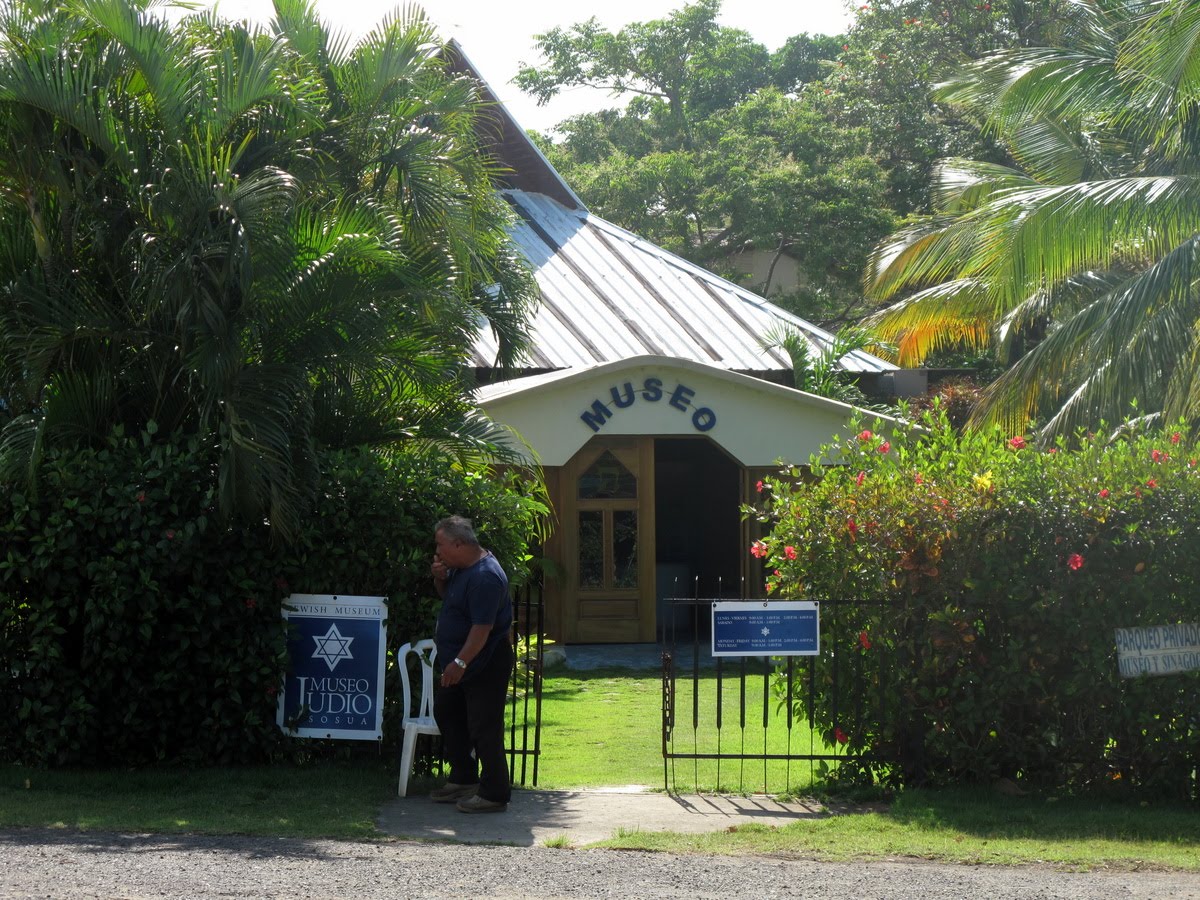
Since there was only one dive today, I spent the afternoon at the Museo de la Comunidad Judía de Sosúa (Museum of the Sosúa Jewish Community). About 350 families relocated to Sosúa during WWII after the Dominican Republic became the first, and in fact only, country at the Evian Conference to open its borders to refugees.
El Museo
Rafael Trujillo, the Dominican President at the time, not only set an ambitious quota of 100,000 people, he offered 26,000 acres of his own property for their relocation. Trujillo believed it would be advantageous for his country to accept European-educated refugees. He apparently disagreed with the belief in Jewish racial inferiority. Not as much can be said for his policies towards other races (Trujillo is infamous in Hispaniola for anti-Black racism, authoritarian practices, and massacres of Haitians).
Museo Judio
In the end only about 5,000 Jews made it to the Dominican Republic, most of whom eventually left for the United States. A letter written by a Jewish woman who arrived in the DR at the age of 13 was on display at the museum. It gave some insight as to why so few made it, despite the government's willingness to accept them. She said they had to travel from Switzerland, through France, Spain, Portugal, and the United States to get here. They needed a separate visa to pass through each of the countries. By the time one had granted passage, the visa for another had expired. Eventually all the stars aligned and their family made the voyage. Evidently, most others weren't so lucky. Also on display was the Nazi passport of one of the refugees with a big red "J" stamped across the holder's name.
The thing that had the greatest impact on me was another letter (dated 1990) from a man whose parents had brought him as an infant to Sosúa before moving permanently to the United States. The purpose of the letter was to express regret that he would not be able to attend a reunion of Sosúa refugees and to offer his old Dominican passport for display in the museum. He added a personal note that he had two children born in the United states, who therefore held passports that allowed them to travel to just about any country in the world at just about any time they pleased. It struck me just how much we Americans take for granted our freedom to move about. Most of the world, even today, must apply for visas far in advance and pay prohibitive fees before they can travel.
The diving here on the North Coast is decidedly mediocre. I've been on 5 dives so far, and I'm pretty glad I'm not paying for it. I'm supposed to be giving pictures in exchange for my diving, but without subject matter, I can't produce much. I've gotten a few good shots, but I'd have gotten several more in the same number of dives on South Caicos.
The reef is pretty sickly here. There are barely any hard corals. There is good coverage of soft corals, but they are sort of gray and sick. Fish are sparse and big fish are non-existent, not even Barracudas! Lionfish are everywhere, and the most abundant fishes of any healthy reef (Grunts and Parrotfishes) are dwindling. I haven't seen a single Snapper or Grouper (the fishes with the highest commercial value).
I took about 100 pictures of this Spinyhead Blenny. They are so small, I just could not get it to focus.
This one would have been great!
That said, there are some things to see. Scorpionfish are pretty common and there are loads of Lizardfish. Butterflyfishes seem to be doing okay. And I've seen several of Jessee's favorite - the Sharpnose Puffer. And there are eels.
Scorpionfish
Bearded Fireworm
Yesterday morning we went out to the "Zingara," a wreck sunk for diving. I was really looking forward to it (and it was good), but a purposefully sunk ship just doesn't have the same draw as something that has history. It's also stripped of anything dangerous (a good thing), so it's really just diving to see a piece of trash.
The Zingara
The Zingara
Looking Inside
This morning Tauchschule Merlin had no clients. The agreement was that I could dive for free as long as the boat was already going out. So instead, Christian (the instructor) and I hitched a ride on one of the other dive company's boats and went Lionfish hunting. He has a proper spear gun, which is far more effective than the metal rod we were using back on South. He got about 10. I was just there taking pictures and providing support. The fish were deep and it ended up being a decompression dive. I was a little bit annoyed that he hadn't planned it as a deco dive to begin with, but all ended fine.
Christian hunting.
A casualty.
I'm not sure how many people they'll have tomorrow either, but I'll show up again in the morning for the same routine. They have a planned dive at the Dudu Caverns for Thursday, for which one person is already signed up. They need at least 3 to go. I'm really hoping that it will. They are fresh water caverns outside of a nearby town. It's only for experienced divers and it sounds really good.
There are two things that are fairly certain about food in Latin America; the rice is good and the pasta is bad. Apart from that, you can count on it being difficult to things such as quality pizza. So far, however, the Dominican Republic has proved otherwise. The pizza I've eaten here outdoes pretty much everything I've had west of Delaware (yes, I realize there's an awful lot west of Delaware). So what explains this anomaly?
I'll venture a guess. According to my guidebook, by 1990 nearly 900,000 Dominicans had emigrated to New York City (that was 12% of the total population!). Most probably put down roots in The City and stayed, but some (including a man that later became president) returned. My suspicion is that they brought with them the knowledge of how to make truly excellent pizza.
I used my first full day in the DR to go on two dives. And now I'm really worn out. They were pretty shallow dives (compared to what I'm used to), so they lasted a really long time. The first one was to a site called the Airport Wall, right in front of the airport where I arrived. I'm glad it wasn't my only dive of the day because I wasn't all that impressed with it. There was really dense soft coral cover, but hardly any hard corals. The visibility was quite poor, and the "wall" is more like a ledge compared with what we have on South Caicos.
This fish here seem to be more skittish than back in the TCI. The divemaster warned that we shouldn't expect to see any big fish because there are so many "big fishermen." That's probably the reason none of the little ones let you get close. That is, all except the Lionfish. And ohhh, the Lionfish! We thought the TCI had a problem. The Dominican Republic has a Lionfish problem. On the two dives I counted 26, give or take a couple. And that was even after another group had taken 11 off the same reef that morning.
Goldentail Moray
Christmas Tree Worms
The second dive, to a place called 3 Rocks, was much nicer. Visibility was quite good and there was a lot to see. It was super crowded though. It's mostly the same species of fish here as in South Caicos, but there are a few new ones and the composition is different. Spotted Drums, for example, are abundant and there are almost no Barracudas. And I saw a Yellow Stingray for the first time.
A Fireworm
Some Barracuda-like fish I haven't identified yet. They're smaller than Barracuda and Barracuda don't school like this.
Most of the client divers are frighteningly unskilled. They are worse than most I've seen. They have very poor buoyancy control, kick up silt, and somewhat destructive to the reef. There's visible damage from years of this going on too, such as broken corals and torn sea fans. It was also apparent that people have been feeding the fishes at 3 Rocks. Yellowtail Snappers and Sergeant Majors swim right up to you looking for food. One even nipped me on my knuckle while I was taking a picture.
The dive shop is closed on Sundays, so I'll have to wait until Monday for the next dive. The plan, I believe, is to go to the Zingara, a boat that was intentionally sunk for diving.
I've arrived in the the Dominican Republic. It took most of the day to get here, despite only being about 100 miles away. The first flight (to Provo) was 20 minutes and the second flight (to Puerto Plata) was only another 40 minutes. But I had a layover of about 5 hours in between. It wasn't so bad though, because it gave me the chance to walk down the street and get some Chinese food. It's simple things like that, that I really miss living on South Caicos.
Lunch in Provo
The very first thing that stood out about the Dominican Republic is that it is green. When you fly over the TCI you mostly see scrub vegetation on sandy, rocky terrain. But flying into the DR, everything is green, there are plantations and palm trees. It's a far bigger island with high mountains, so a lot of rain falls here, making it much more lush environment. This, however, I expect will have a detrimental effect on visibility underwater (more runoff, means more sediment in the water).
After landing, they led us through an absurdly long maze of corridors to immigration, where they charged me $10 to get into the country! It was a little bit silly how they did it, but there was an official looking desk and the immigration officer wouldn't let me through without paying, so I'm pretty sure it was legitimate.
The hotel I'm staying at offers free pickup for guests who stay longer than a week, the person who was supposed to pick me up from the airport was late. I waited for a while and told at least a dozen people that I didn't need a taxi or a "motoconcho" (motorcycle taxi). Eventually I found a way to call the hotel. Apparently the website for Air TCI said my flight hadn't taken off yet. I wasn't at all surprised. A Canadian who works at the hotel came to get me finally. The place I'm staying at, Rocky's Hotel, is pretty dingy. But I can't expect much when my method for choosing a hotel was to scan the listings for the lowest possible rate.
My Room
After I unpacked, I went into town with three objectives: find the dive center I'll be diving with, buy some cheap sandals (mine broke recently), and find a place to get some water. I achieved two out of three, and I'm feeling a little bit parched at the moment.
The city of Sosúa is a pretty typical Latin American tourist town from what I can tell so far. The exception, however, is that it seems prostitution is big business here. The guy from the hotel told me already that most people come to Sosúa "for the girls." I made it clear I was here to go diving.
The Street
Tauchschule Merlin
I'll be diving with Tauchschule Merlin (Diving School Merlin), a German-run dive center right down on Sosúa beach. They gave me a great welcome, and I'm really excited about diving with them. They told me to meet them back at the shop at 9am tomorrow morning for the first dive. I can't wait.
Playa Sosúa
Tourist Traps
A boat at the beach.
Right around the corner I found a place to get some sandals. I bargained down to what I was pretty sure was a fair price, but after purchasing them I promptly found them for $8 cheaper at another place. Oh well, they were still less than what I would have paid on South Caicos or Provo.
More likely than not, they're knock-offs.
I decided to come back to the room to write this up, and I'll attempt to find some dinner a little later on. My first impression of the place wasn't so good (tourist destinations centered around nightlife don't really appeal to me), but after meeting the people at the dive center, I'm feeling a little better about things.
 Smooth Trunkfish
 A group of Squid
 The tiniest Lionfish ever. It was as long as my finger is wide.
 Yellowline Arrow Crab
 Smooth Trunkfish looking for scraps.
 Scorpionfish saying "I'm Deadly!"
 Lionfish on a Sponge
 That's 320 pesos, not dollars. That's less than $9 to all the way across the country!




 Posts
Posts

